Revenue accounting is the practice of recording, tracking and reporting revenue under the standards that govern it: ASC 606 in the United States, IFRS 15 elsewhere. It has one rule that everything else follows from. A company recognizes revenue when it earns it, not when the cash arrives.
For enterprise technology and SaaS companies, this distinction is not academic. Revenue accounting done well keeps you compliant, makes forecasts trustworthy and holds up under audit. Done poorly, it creates restatements and lost credibility. This article explains the principles, the common exceptions and the systems finance leaders rely on to get it right.
Key takeaways
- Revenue accounting recognizes revenue when control of goods or services transfers to the customer, not when cash arrives.
- ASC 606 (US GAAP) and IFRS 15 (international) govern revenue recognition through a five-step model in force since 2018.
- Accrual-basis revenue accounting reveals business health that cash-basis accounting hides, which is why companies reporting under US GAAP or IFRS use it.
- Deferred revenue is a liability: cash collected upfront moves into recognized revenue ratably as the company delivers the service.
- Usage-based pricing, ramped multi-year deals and variable consideration are where standard principles need expert judgment and system support.
Table of contents
- What Is Revenue Accounting?
- Why Revenue Accounting Matters for Your Business
- How Revenue Accounting Differs from Cash Accounting
- Key Revenue Accounting Principles in Practice
- Deferred Revenue: When the Customer Pays First
- Who Handles Revenue Accounting in Your Organization
- When Revenue Accounting Gets Complex: Exceptions and Limits
- How Flexible Billing Systems Enable Accurate Revenue Accounting
- Setting Up Revenue Accounting: First Steps
- FAQ
What Is Revenue Accounting?
Under ASC 606 and IFRS 15, a company recognizes revenue when control of a promised good or service transfers to the customer. Payment timing does not decide when revenue is recognized.
For a SaaS subscription, that transfer happens continuously, so the company recognizes revenue ratably over the subscription term. IFRS 15, published by the IFRS Foundation, states the core principle. Revenue should depict the transfer of promised goods or services. The amount should reflect the consideration the company expects to be entitled to.
Not all revenue behaves the same way. A perpetual license delivered at a point in time counts as revenue on delivery. Cloud access, in contrast, counts over time because the customer consumes the benefit across the service period. A single deal can contain subscription, onboarding, usage and professional services lines. Each one that is a distinct performance obligation recognizes on its own schedule, and deciding which are distinct is a judgment call.
Why Revenue Accounting Matters for Your Business
Accurate revenue accounting matters because misstated revenue triggers compliance violations, breaks financial forecasts and erodes investor confidence. Revenue recognition is one of the most common causes of restatements. In 2025 it ranked second among issues cited in public company restatements at 14%, behind debt and equity classification at 27%.
Pull revenue forward or push it back incorrectly and reported growth stops matching the business. Board forecasts miss, and a restatement can cost credibility built over years. Take a three-year ramp deal billed at $100,000, $150,000 and $200,000. Recognition usually follows delivery, so a service delivered evenly is typically recognized at $150,000 a year. The gap against billing sits on the balance sheet as a contract asset, which builds to $50,000 in year one and unwinds in year three. Whether an even schedule is right depends on whether the ramp reflects the value delivered. That is a judgment call, and auditors test it.
Accurate revenue accounting also feeds better decisions internally. When recognized revenue is trustworthy, you can forecast with confidence and price new offerings against real margin. You can also defend your numbers to auditors without a fire drill each quarter.
How Revenue Accounting Differs from Cash Accounting
Revenue accounting runs on the accrual basis and records revenue when the company earns it. In contrast, cash accounting records revenue only when payment arrives. The two methods can report wildly different results for the same business in the same period. That is why the distinction matters so much for technology firms.
Take a prepaid annual subscription. Cash accounting books the full payment the day it clears. Accrual-basis revenue accounting recognizes it month by month as the company delivers the service and parks the rest as deferred revenue.
Dimension | Cash accounting | Accrual revenue accounting. Trigger for recognition: cash received versus control transfers or service delivered. $12,000 annual prepay: $12,000 in month one versus $1,000 per month for 12 months. Reveals: liquidity versus true operating performance. ASC 606 compliant: no versus yes.
Companies that report under US GAAP or IFRS must recognize revenue on the accrual basis. Subscription and usage models often collect cash on schedules that differ from when the customer receives value. Accrual accounting is what shows the underlying health of the business.
Key Revenue Accounting Principles in Practice
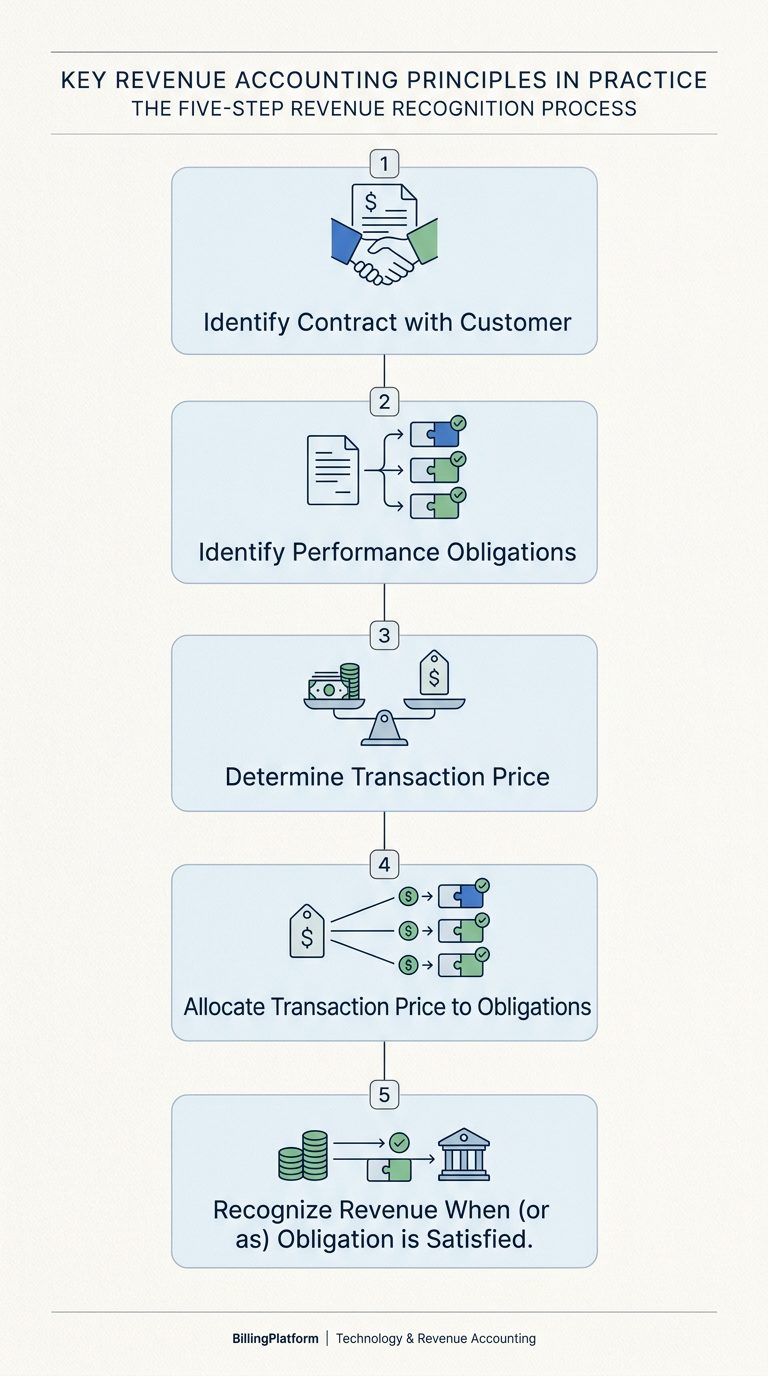
The key principle in practice is the ASC 606 five-step model. It has governed US GAAP revenue recognition since 2018 for public companies, and later for private ones. KPMG’s December 2025 software and SaaS handbook still applies it. It applies whether you sell licenses, subscriptions, usage or a mix.
The five steps are:
- Identify the contract with the customer.
- Identify the performance obligations in the contract.
- Determine the transaction price.
- Allocate the transaction price to the performance obligations.
- Recognize revenue when or as you satisfy each obligation.
Each step carries judgment. KPMG’s December 2025 handbook on revenue for software and SaaS says these arrangements require significant judgments and estimates and that contract modifications keep raising questions. The judgment concentrates in four areas: contract assessment, performance obligations, standalone selling price and allocation. For a full walkthrough of each step with examples, see BillingPlatform’s 5 steps of revenue recognition guide. In addition, its overview of what ASC 606 is covers the standard itself.
Deferred Revenue: When the Customer Pays First
Deferred revenue is cash a company receives before it delivers the promised service or product. It sits as a liability on the balance sheet until the company satisfies the obligation. It is one of the most common balance-sheet items in SaaS. That is because billing and delivery run on different clocks.
Take a customer who pays $12,000 upfront for a one-year subscription. On day one the company holds $12,000 in cash but has delivered nothing. The full amount sits as deferred revenue, a liability. Each month it delivers service, $1,000 moves from deferred revenue into recognized revenue. By month twelve the liability is zero and the company has earned all $12,000.
The liability framing matters: deferred revenue, which ASC 606 calls a contract liability, represents a promise the company still owes, not profit it has booked. For how it sits alongside related concepts, see BillingPlatform’s explainer on contract assets versus receivables versus deferred revenue. Operating metrics like MRR, ARR and NRR describe the same contracts, but they are not revenue-recognition standards. Never report them as GAAP revenue.
Who Handles Revenue Accounting in Your Organization
Revenue accounting is a shared responsibility across finance, revenue operations and the billing system, each owning a different layer. First, finance produces the accounting and financial statements. Second, revenue operations manages the data feeds and systems that supply the inputs to those recognition decisions. Third, billing systems capture the transaction detail both depend on.
- Finance and accounting teams own the recognition policy, the judgment calls, the journal entries, the schedules, the close and the audit defense.
- Revenue operations owns the connective tissue. That means the data flows from CRM and CPQ, the contract terms and the systems that map billing events to recognition rules. See BillingPlatform’s overview of revenue operations for how teams structure the function.
- Billing systems capture what the company sold, at what price, on what terms and when it delivered.
BillingPlatform covers the billing layer and, for customers who use its revenue recognition module, the recognition schedules built from that data. If the source data is wrong, every downstream schedule is wrong too.
When Revenue Accounting Gets Complex: Exceptions and Limits
Standard revenue accounting principles strain in three scenarios. The first is ramped multi-year contracts. Next come usage-based pricing and contract modifications that change the price mid-term. In each, the timing and amount of recognition require judgment that no default schedule handles on its own.
- Ramped multi-year deals step pricing up over the term. The cash schedule and the recognition schedule diverge, and finance has to reconcile them contract by contract.
- Usage-based pricing produces revenue that is only knowable after consumption happens. ASC 606 often treats it as variable consideration that finance estimates and trues up. For a flat rate per unit, a practical expedient or allocation exception often lets the company recognize revenue as usage occurs. Minimum commitments and retroactive tiers usually break that shortcut.
- Dynamic pricing and contract modifications force reallocation of the transaction price mid-contract.
KPMG’s 2025 software and SaaS handbook lists the hardest recurring judgments. Is implementation a distinct performance obligation? Are support and training separate promises? How do you estimate variable consideration, and how do you defend standalone selling price to auditors? Companies operating at this level need technical accounting expertise and a system built for the work, not a spreadsheet.
Revenue Accounting doesn’t have to be complicated. This white paper breaks down 5 common challenges and how to rise above them.
Who this is not for
Revenue accounting automation is not for early-stage companies with a handful of flat-rate subscriptions and no material deferred revenue. If your contracts are uniform and your pricing is fixed, cash and revenue timing barely diverge. In that case, a simple accrual schedule in your accounting software is enough. The judgment-heavy machinery described here earns its keep when contracts vary or usage drives revenue. It also pays off when you are preparing for audit or public reporting. Buying enterprise tooling before that point adds cost without solving a problem you do not have yet.
How Flexible Billing Systems Enable Accurate Revenue Accounting
Flexible billing systems enable accurate revenue accounting by automating the capture, calculation and audit trail that recognition depends on. In turn, that reduces the manual journal entries where errors and late recognition creep in. When recognition runs off live billing data, the recognized numbers stay aligned with the source of truth. A separate close-cycle export cannot promise that.
A platform that rates usage as it arrives and records contract modifications holds most of the data ASC 606 needs. Allocation and recognition can then run from that data for standard contract structures, with manual work limited to the exceptions. BillingPlatform applies the five-step model in the same system that bills the contract, with no export step between billing and recognition. It allocates the transaction price across performance obligations using standalone selling price profiles and the residual method, and it supports contract modifications on existing revenue contracts. Your accounting team still sets the SSP policy and owns the judgment calls.
The payoff is fewer manual entries, a cleaner audit trail and recognition that keeps pace with the contract. Tipalti cut its average time to close by 40% after dropping the monthly reconciliation between billed and recognized revenue. For the broader picture of how automation reduces close-cycle risk, see BillingPlatform’s overview of billing automation.
Setting Up Revenue Accounting: First Steps
Setting up revenue accounting starts with your contracts and ends with a repeatable monthly close. The practical workflow is a sequence, not a single project. Each step depends on the one before it.
- Audit your contract terms to identify every performance obligation, including implementation, support, usage and professional services that may recognize separately.
- Configure your billing system to tag revenue by recognition date so each line item carries the schedule it belongs to.
- Map your chart of accounts to ASC 606 line items, keeping deferred revenue and recognized revenue clearly separated.
- Establish a monthly close process to review and post deferred revenue movements, true up variable consideration and reconcile against billing.
The concrete next step for a finance leader is simple. First, pull your five most complex active contracts and trace how each one currently recognizes revenue. If the schedules live in spreadsheets or need manual entries each month, that is your signal. Then test each option on one question: can each of those five contracts recognize revenue from billing data with no export and no side spreadsheet? The options are your current spreadsheets plus ERP, a standalone revenue recognition tool or a billing platform that recognizes revenue itself.
FAQ
What is the difference between revenue accounting and revenue recognition?
Revenue recognition is the rule set, ASC 606 and IFRS 15, that decides when and how much revenue counts as earned. Revenue accounting, in contrast, is the practice built around those rules. It means recording the entries, maintaining the schedules, reconciling deferred balances and closing the books. In short, one is the standard, the other is the work.
What is the difference between revenue accounting and cash accounting?
Revenue accounting uses the accrual basis and records revenue when the company earns it. Cash accounting records revenue only when payment arrives. For a $12,000 annual subscription paid upfront, cash accounting books all $12,000 immediately. Revenue accounting, however, recognizes $1,000 per month over the year.
Is deferred revenue an asset or a liability?
Deferred revenue is a liability. It represents cash a company has collected for a service it has not yet delivered. In other words, the company still owes the customer that service. As the company delivers the service, the deferred revenue balance moves into recognized revenue.
What standard governs revenue accounting for SaaS companies?
In the United States, ASC 606 governs revenue accounting, using a five-step model in force since 2018. Internationally, IFRS 15 sets the equivalent core principle. Both recognize SaaS subscription revenue over time as the customer consumes the service.
Are MRR and ARR the same as recognized revenue?
No. MRR, ARR and NRR are SaaS operating metrics that describe contract value, growth and retention. They are not revenue-recognition standards. Therefore, do not report them as GAAP or IFRS revenue, which follows the ASC 606 or IFRS 15 recognition rules.